
Your operation captures the evidence. PackProof brings it together.
An order confirmation in one system. A warehouse scan in another. Loading records, delivery notes, photographs and receiving information spread across the rest.
Each source holds part of the story. When someone needs to understand a shipment, the work often begins with finding those pieces and figuring out how they fit together.
PackProof’s logistics evidence record is designed to bring that work forward: organize the available evidence around the order, preserve its source context, and make the record easier to review before a question becomes an urgent investigation.
The result we are building toward is simple: less time assembling the story, more time understanding it.
Product preview · Sample data. The record shown here uses fictional sample data. Production integrations, supported sources and reconciliation rules are scoped for each deployment; the preview does not perform live integrity checks.
Key points
- Five connected views organize the order, items, journey, evidence and record history.
- Source-linked observations make a discrepancy visible without determining its cause or responsibility.
- Committed originals and their source context remain available behind the organized view.
- A historical-data pilot can measure review time, unresolved gaps and the work needed to maintain connections.
Product preview · Sample data
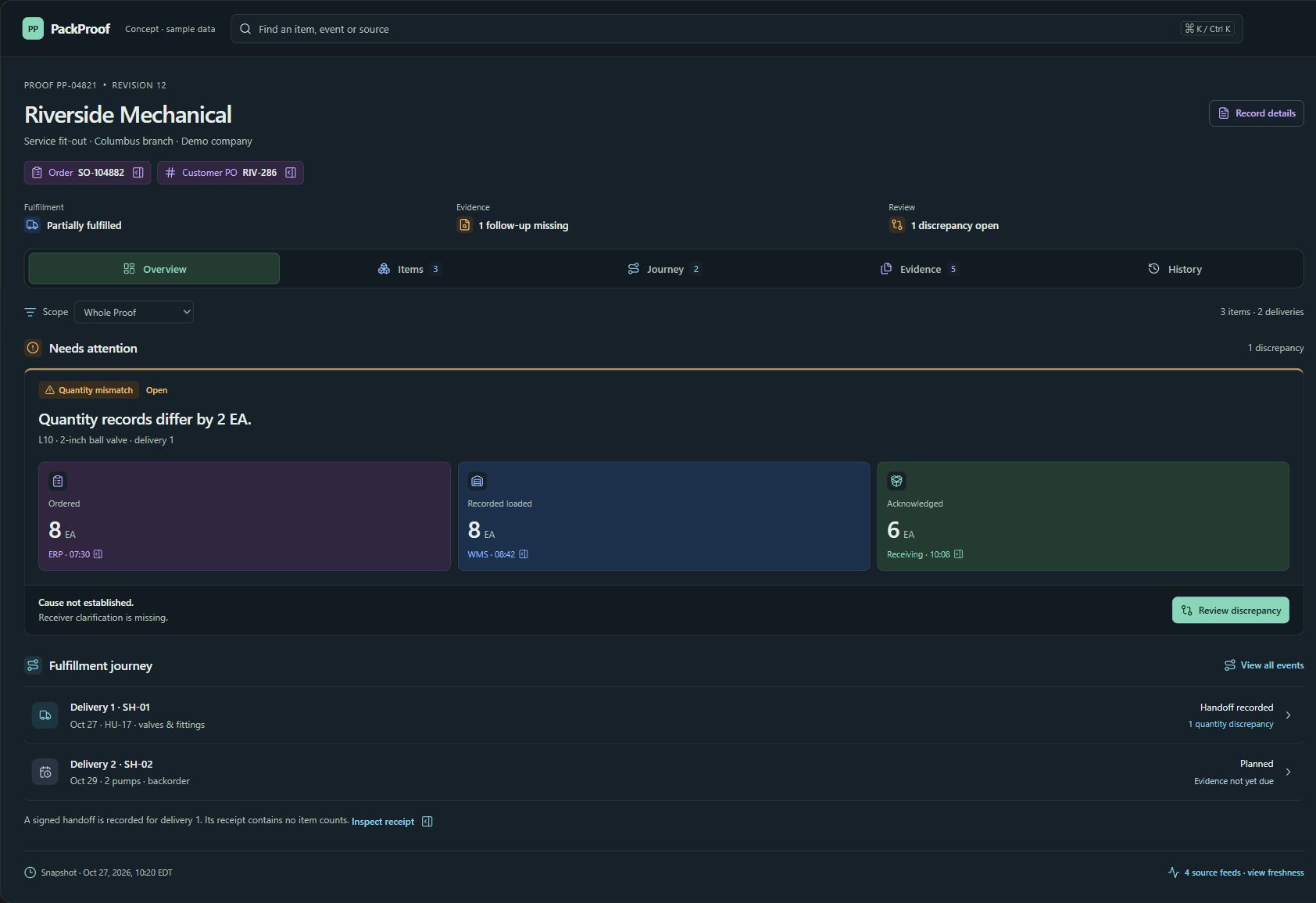
A record built around the question you need to answer
A useful evidence record should help an operations manager move from “What needs attention?” to the exact source behind it, without searching through every system again.
The new PackProof record organizes that review into five connected views:
- Overview: the order’s current picture, fulfillment progress and open questions.
- Items: quantities at each recorded stage, with the source behind each observation.
- Journey: the sequence of recorded events across deliveries and handoffs.
- Evidence: the original source records and their identifying details.
- History: the activity and changes that explain how the record developed.
A reviewer can stay with the whole order or focus on one delivery. Search within the Proof helps locate an item, a source record or a review issue. From there, the underlying observation remains close at hand.
This structure matters when an order spans several movements. A completed first delivery and a planned second delivery should remain distinct. Evidence that is not yet due should not appear as a failed or missing event.
Put discrepancies in context
In the sample record, one item has three observations:
8 ordered. 8 recorded loaded. 6 acknowledged by receiving.
The Overview brings the two-unit difference to the reviewer’s attention. Selecting a quantity opens its source, so the reviewer can see where the number came from and which stage it describes.
Product preview · Sample data
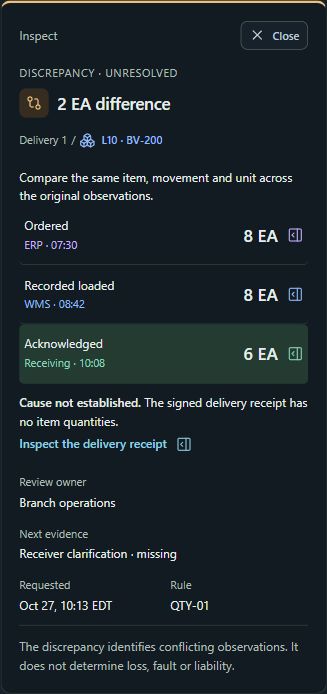
That is a much more useful starting point than an unexplained warning. The record identifies the discrepancy, preserves the competing observations and shows what evidence would help clarify it.
It also keeps the conclusion proportionate to the evidence. A difference between recorded quantities does not establish where an item went missing, whether a count was entered incorrectly, or who is responsible. In this example, the signed handoff contains no item quantities. The record keeps that limitation visible.
The purpose of reconciliation is to direct attention to a question worth reviewing. People retain responsibility for the operational decision.
Keep the original behind the organized view
Making evidence easier to read should not strip away the details needed to check it.
PackProof’s evidence model preserves committed originals and their recorded references. The logistics record applies that principle to the review experience: a readable summary leads back to its source, including the source system, record revision and relevant timestamps.
Product preview · Sample data
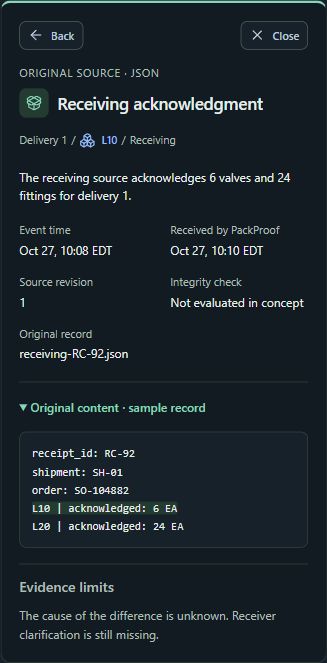
A warehouse event time and the time PackProof received that event can tell different stories. Both deserve a clear label. A later clarification should add context without silently replacing the earlier observation.
This is what makes an organized record valuable: the detail remains available when someone needs to inspect it.
Read more about PackProof’s evidence and integrity model.
Prepare the record before the issue arrives
The opportunity extends beyond resolving a complaint.
A team may need to review a routine delivery, answer a customer’s question, investigate a mismatch, or prepare the evidence for another department. An order-linked record gives those reviews a consistent starting point.
The aim is to connect supported evidence as it becomes available, so teams do not have to rebuild the shipment’s history under pressure. Clear navigation and source-linked observations can reduce the work involved in finding the relevant material. The actual time saved is something to measure on the operation’s own shipments.
Start with the systems and evidence you already have
PackProof’s approach is to work alongside the systems running the operation. Order, warehouse, dispatch and receiving records each have a role. A connected evidence record gives reviewers a way to examine them together.
A focused pilot can start with a small set of historical shipments and the records already available. Agree the supported formats, identifiers and permissions, then compare how the same shipment questions are answered with and without the consolidated record.
Useful measures include:
- Time needed to find the relevant evidence.
- Time needed to prepare a review.
- Sources or gaps that remain unresolved.
- Additional work required to maintain the connection.
That produces a practical basis for deciding where a broader rollout would help.
A clearer record of what happened
The value is in making existing evidence easier to find, understand and inspect together.
That is the direction of PackProof for logistics and fulfillment: one connected record for the order, with the relevant detail close at hand and the original sources still in view.
Discuss a historical-data pilot with PackProof.
See the record in context.
Explore how PackProof connects the order, available evidence, and shipping activity.
Discuss a historical-data pilot →